

Beyond Jump Height: Smarter ACL and Achilles Rehab Testing
By
Dr. Mike Makher
New research shows jump height alone misses hidden weakness after ACL surgery. See how Hillsboro, Beaverton, and Forest Grove patients get safer return to sport testing.
Disclaimer: This article is for educational purposes only. It should not be seen as medical advice. Every case and person is unique, so treatment and prevention should be customized by a licensed professional.
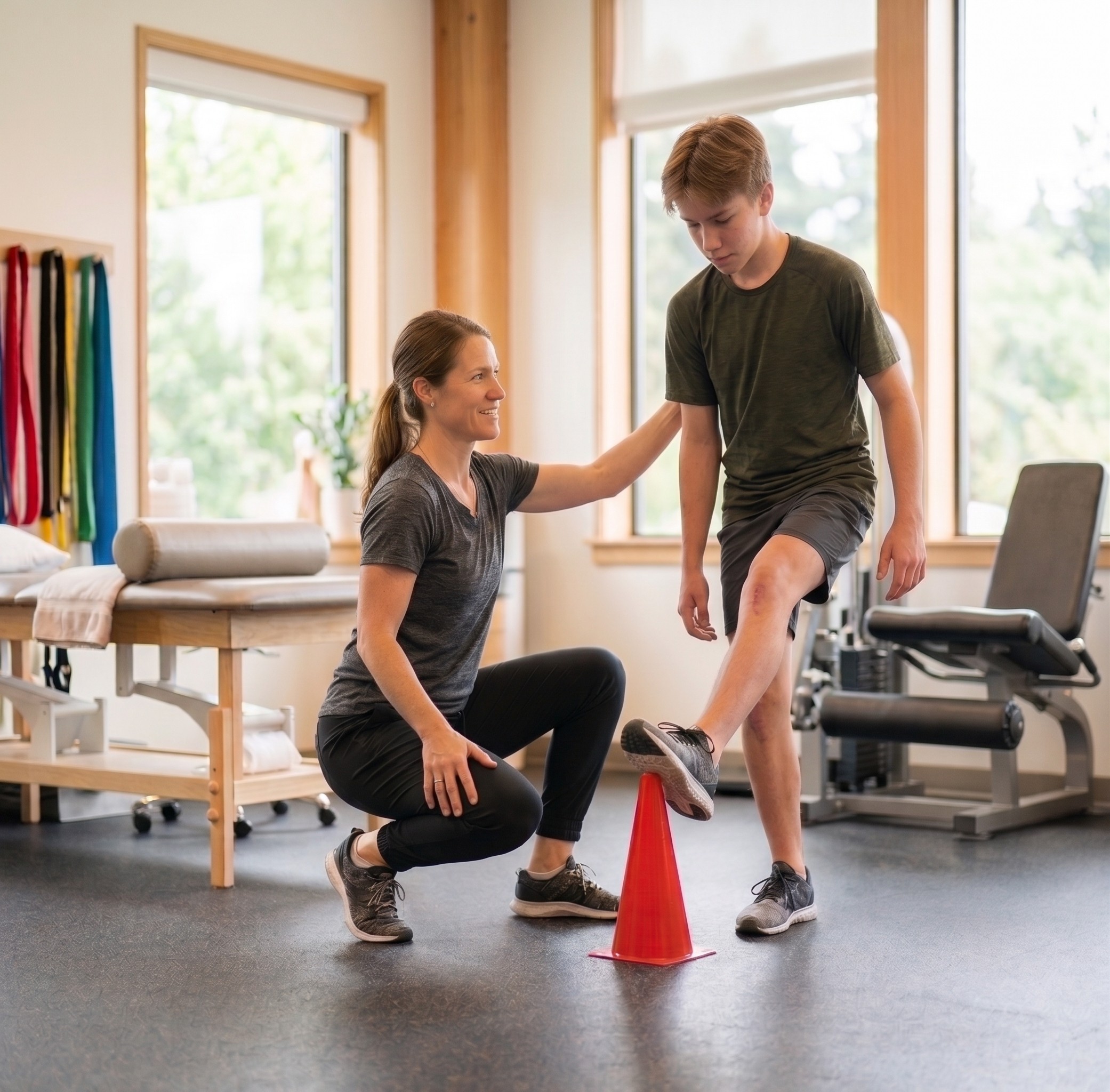
Beyond Jump Height: What New Research Means for ACL and Achilles Recovery in Hillsboro and the West Side
Disclaimer: This article is for general educational purposes only and is not medical advice. It does not replace an evaluation, diagnosis, or treatment plan from a licensed healthcare provider. Every injury and recovery is different, so the guidelines and benchmarks described here may not apply to your situation. Always talk with your surgeon, physician, or physical therapist before starting, stopping, or changing any exercise or rehabilitation program. Reading this article does not create a patient and provider relationship with [Clinic Name]. If you are experiencing new pain, swelling, or instability, please contact your healthcare provider right away.
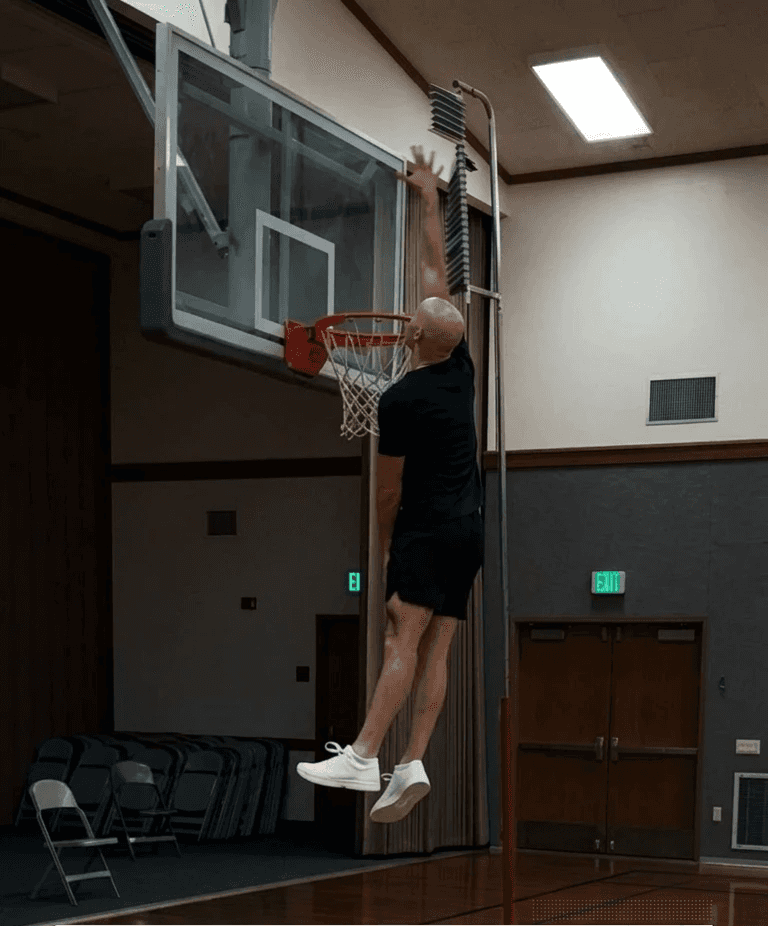
If you've torn your ACL or had your Achilles tendon repaired, one question probably keeps coming up: When am I actually ready to get back to my sport?
For years, the answer was based mostly on time ("you're 9 months out, you're good") or on simple tests like how far you can hop on one leg. A new article published in September 2026 in the journal Physiotherapy Theory and Practice makes a strong case that we can do much better than that.
The authors, a group of sports science and rehab researchers from universities in London, Sydney, Perth, Calgary, and Dubai, looked at one of the most common tests in sports medicine: the countermovement jump. Their main finding is simple. How high you jump is only part of the story. What happens inside that jump, and how each leg is contributing, tells us far more about whether your knee or ankle is truly ready.
At Pain & Performance Coach LLC, we work with athletes and active adults across Hillsboro, Aloha, Cornelius, Bethany, Beaverton, North Plains, Forest Grove, and even as far as Lake Oswego who are recovering from ACL reconstruction and Achilles tendon repair. Here's what this research says, in plain language, and why it matters for your recovery.
What Is a Countermovement Jump?
A countermovement jump (often shortened to CMJ) is the most natural jump there is. You stand tall, dip down quickly by bending your hips, knees, and ankles, and then explode straight up. It's the same move you'd use to grab a rebound, spike a volleyball, or jump to catch a ball.
The test can be done on both legs (bilateral) or on one leg (unilateral). When it's done on a force plate, which is a special platform that measures how hard you push into the ground thousands of times per second, it gives your physical therapist a detailed picture of how your body is producing and absorbing force.
Why the Old Way of Testing Falls Short
Traditionally, many clinics tested ACL patients using the single leg hop for distance. You hop as far as you can on your injured leg, then on your healthy leg, and the two numbers are compared.
The problem is that research has repeatedly shown hop distance can look normal even when the knee is still weak. The body finds workarounds, often more so with more athletic individuals. You might hop just as far by subtly leaning more on your hip or ankle, while your knee quietly does less of the work. The final number looks great, but the underlying weakness is still there.
The authors point to growing evidence that vertical jump testing is better than horizontal hop testing at picking up these leftover deficits after ACL injury. That's a big deal, because leftover weakness is one of the things we worry about most when someone returns to cutting, pivoting, and landing sports.
The Challenge: Too Much Data
Here's a problem most patients never hear about. Modern force plates can produce more than 100 different measurements from a single jump. Many of them have similar names and very small differences in how they are calculated. Without a clear plan, it's easy to get confused and get lost in numbers that don't actually help with decisions.
The researchers outlined four common traps:
1. Too many metrics to choose from. More data isn't better if nobody knows which numbers matter.
2. Some measurements aren't reliable. Every test has some natural "noise." If a measurement changes a lot from jump to jump even when nothing has really changed, it can't tell us much. The authors suggest aiming for measurements that vary by roughly 5% or less between trials, which is stricter than the 10% that's often used. They also recommend retesting no sooner than about 4 weeks apart, so there's enough time for real change to happen.
3. Poor test setup. Small details matter. For example, you need to stand completely still on the plate for at least 1 second before jumping so the system can accurately measure your body weight. Skip that step and every number that follows can be off.
4. The "collinearity trap." This is a fancy term for measuring the same thing three different ways. Jump height, takeoff speed, and a measure called net impulse are all closely tied together. Tracking all three doesn't give you three times the information. It mostly gives you the same answer in different units.
When Is It Safe to Start Jump Testing After ACL Surgery?
One of the most useful parts of this article for patients is the guidance on when jump testing should begin. A common approach is to start around 3 months after surgery. The authors point out that a calendar date doesn't account for how differently people heal. Some are ready sooner, some later.
Instead, they recommend a criteria based approach, meaning you move forward when your body shows it's ready. Before jumping, they suggest a patient should typically have:
Little to no swelling in the knee
A stable knee on clinical testing (the Lachman test, which checks the ACL graft)
Full knee straightening, and ideally a little extra
Knee bending past 120 degrees
Pain kept low, around 0 to 3 out of 10
Solid quad strength. On strength testing equipment, the authors suggest a reasonable minimum of about 5.5 to 6.5 units of force (N) per kilogram of body weight at 3 months. Without equipment, a single leg knee extension of about 40% to 50% of body weight may be a rough guide, though they note this is based on experience rather than hard evidence.
They also stress that jumping isn't just a knee activity. The hip, knee, and ankle share the work fairly evenly when you jump straight up, and the calf muscle (especially the soleus) plays an important role right at takeoff. So they recommend patients show basic strength there too, such as more than 25 single leg calf raises and more than 25 single leg glute bridges.
Finally, movement quality matters. Around 3 months after surgery, patients should generally be able to do a controlled single leg squat to about 70 degrees of knee bend. On force plates, a two leg squat should show less than a 10% difference between legs.
Patients also fill out questionnaires about knee function and confidence, because how you feel about your knee is part of readiness too.
The 6 Measurements That Matter Most
Out of those 100+ possible numbers, the authors recommend physical therapists focus on six. Here's what each one means in everyday terms.
1. Jump Height
This is the headline number, and the one athletes, parents, and coaches understand best. It also connects well with other athletic qualities like sprint speed and change of direction ability. It still matters. It just shouldn't be the only thing we look at.
2. Mean Propulsive Force
This is the average push you create while driving up off the ground. Think of it as the engine. If your jump height isn't improving, this number often explains why. It shows how well your leg's ability to generate force has come back.
3. Mean Braking Force
This is the average force you use to slow yourself down during the dip before you jump. It's especially important for ACL patients, because many ACL injuries happen when the body has to absorb a lot of force in a very short time, like landing awkwardly or stopping suddenly. The authors prefer the average braking force over the peak because the average reflects the whole movement rather than a single split second.
4. Countermovement Depth
This is simply how low you dip before you jump. It gives context to braking force. If someone starts dipping less deeply (a common sign of guarding or protecting the knee), their braking force may look different for reasons that have nothing to do with getting stronger. Tracking depth helps us read the other numbers correctly.
5. Mean Landing Force
What goes up must come down. How well you absorb force when you land may be even more closely tied to injury risk than how well you push off, since landing more closely matches how many ACL injuries actually happen.
6. Side to Side Differences (Asymmetry)
Comparing your injured leg to your healthy leg is a core part of rehab. But the authors add an important warning here. A smaller difference between legs doesn't always mean the injured leg got stronger. Sometimes the healthy leg has gotten weaker from months of reduced activity. If both legs decline, the gap shrinks and it can look like progress when it isn't. That's why we look at the actual numbers for each leg, not just the percentage difference.
Two Legs vs. One Leg: Why Both Tests Matter
The researchers explain that the two leg jump and the one leg jump tell us different things:
The two leg jump is great for spotting compensation, meaning whether you're shifting weight onto your healthy side without realizing it.
The one leg jump shows the "true" capacity of each leg on its own, since the other leg can't help out.
Both have a place in a complete testing plan.
Why This Matters for Achilles Tendon Repair Recovery
This research focused on ACL injuries, and it's important to be clear about that. The study did not test Achilles patients. However, many of the principles apply directly to Achilles tendon repair rehab, and here's how we use them at Pain & Performance Coach Physical Therapy.
The calf is a major jumping muscle. The article highlights how much the ankle and calf contribute to vertical jumping, especially the soleus right at takeoff. After an Achilles repair, calf strength and power are often the slowest things to come back, and weakness can hang around long after walking feels normal.
People hide calf weakness well. Just like ACL patients can hide quadriceps weakness during a hop test, Achilles patients often shift work to the hip and knee. A simple jump height number may look fine while the calf is still underperforming. Force plate measures like propulsive force, and one leg jump testing, help reveal what's really happening.
Landing and braking matter for the tendon. The Achilles tendon handles large forces every time you land. Tracking braking and landing force helps us see whether the tendon and calf are ready for running, jumping, and quick direction changes.
The healthy side can decline too. The same asymmetry warning applies. After weeks in a boot and reduced activity, the uninjured calf often loses strength. Comparing only side to side percentages can make recovery look further along than it really is.
Criteria before calendar. The same "ready when your body shows it" thinking fits Achilles rehab well. Benchmarks like single leg calf raise endurance and calf strength testing help decide when jumping and hopping should begin, instead of relying on weeks since surgery alone.
What This Means for You as a Patient
If you're recovering from ACL reconstruction or Achilles tendon repair anywhere on the west side of the Portland metro area, from Forest Grove and Cornelius to Hillsboro, Aloha, Bethany, North Plains, and Beaverton, here's the takeaway:
Your return to sport decision should be based on how your body performs, not just the calendar.
Jump height alone can hide weakness. Looking at how you push, brake, and land gives a much clearer picture.
Testing both legs, together and separately, shows both compensation patterns and true leg strength.
Your healthy leg matters too. Keeping it strong protects you and keeps your test results honest.
Good testing is careful testing. Proper setup, reliable measurements, and retesting about every 4 weeks help make sure changes are real.
Frequently Asked Questions
What is the best test to know if I'm ready to return to sport after ACL surgery?
No single test is enough. Current research supports combining strength testing, movement quality checks, questionnaires about confidence, and jump testing that looks beyond jump height, including braking, propulsive, and landing forces.
When can I start jumping after ACL reconstruction?
Many programs start around 3 months after surgery, but research supports using criteria instead of a date. These include minimal swelling, a stable knee, full range of motion, low pain, and adequate quad and calf strength.
Is hop testing still useful?
Hop testing can still offer some information, especially when equipment is limited. However, research shows hop distance alone often misses leftover knee weakness.
Does jump testing help after Achilles tendon repair?
Yes. Although this study focused on ACL patients, the calf plays a large role in jumping. Force plate jump testing can help reveal calf weakness and compensation patterns during Achilles recovery.
Where can I get ACL or Achilles rehab testing near Hillsboro, Oregon?
Pain & Performance Coach Physical Therapy provides scientifically backed criteria based ACL and Achilles rehabilitation for patients from Hillsboro, Aloha, Cornelius, Bethany, Beaverton, North Plains, and Forest Grove.
Ready to Take the Guesswork Out of Your Recovery?
Returning to sport too early is one of the biggest risk factors for re-injury. Returning too late is just wasting time. The goal in rehab is to get it right by using clear and reliable information about how your body is actually performing.
If you're recovering from an ACL reconstruction or Achilles tendon repair, or if you're a coach or parent supporting an athlete who is, contact us at Pain & Performance Coach today to schedule an evaluation. We proudly serve Hillsboro, Aloha, Cornelius, Bethany, Beaverton, North Plains, Forest Grove, and the surrounding Washington County communities.
You can reach us via phone at 971-364-0909 or fill out our contact form on this website.
Disclaimer: This article is for general educational purposes only and is not medical advice. It does not replace an evaluation, diagnosis, or treatment plan from a licensed healthcare provider. Every injury and recovery is different, so the guidelines and benchmarks described here may not apply to your situation. Always talk with your surgeon, physician, or physical therapist before starting, stopping, or changing any exercise or rehabilitation program. Reading this article does not create a patient and provider relationship with [Clinic Name]. If you are experiencing new pain, swelling, or instability, please contact your healthcare provider right away.
Reference (AMA)
Bishop C, Maestroni L, Bettariga F, Jordan M, Read P, Turner A. Beyond jump height: monitoring countermovement jump metrics across the anterior cruciate ligament rehabilitation journey. Physiother Theory Pract. Published online September 25, 2026. doi:10.1080/09593985.2026.2738832
Don’t Miss Out
Join our newsletter to get latest research insights.
References
Bishop C, Maestroni L, Bettariga F, Jordan M, Read P, Turner A. Beyond jump height: monitoring countermovement jump metrics across the anterior cruciate ligament rehabilitation journey. Physiother Theory Pract. Published online September 25, 2026. doi:10.1080/09593985.2026.2738832
New research shows jump height alone misses hidden weakness after ACL surgery. See how Hillsboro, Beaverton, and Forest Grove patients get safer return to sport testing.
Your ACL Recovery Toolkit: 5 Free Resources Every Patient Should Know About
Sep 23, 2026
By
Dr. Mike Makher
What New Research on Achilles Tendon Recovery Means for Both of Your Legs
Sep 21, 2026
By
Dr. Mike Makher
What New Knee Research Means for Patients in Hillsboro, Beaverton, Aloha, and Nearby Towns
Sep 6, 2026
By
Dr. Mike Makher