
More Than Recovery: How Physical Therapy and Exercise Can Keep Hillsboro, OR Moving for Life
By
Dr. Mike Makher
The Pain & Performance Coach approach to physical therapy in Hillsboro, OR uses tailored strength training, neuromuscular retraining, plyometrics, and running to move you from pain relief to lasting performance.
Disclaimer: This article is for educational purposes only. It should not be seen as medical advice. Every case and person is unique, so treatment and prevention should be customized by a licensed professional.
More Than Recovery: How Physical Therapy and Exercise Can Keep Hillsboro, OR Moving for Life
Most people in Hillsboro, OR and the neighboring towns/cities meet physical therapy at a low point: after an injury, a surgery, or a flare-up of pain that just won't quit. Traditional care often stops the moment the pain calms down. But getting out of pain and getting back to performing at your best are two very different finish lines, and the gap between them is where a lot of people get stuck.
That's the gap Pain & Performance Coach Physical Therapy is built to close. Instead of treating you as a problem to patch, this model treats you as an active individual (or athlete) in your own life whether your "sport" is running a 10K, lifting your grandkids, hiking Forest Park, or simply standing through a workday without dreading it. The tools are the same ones used in elite performance training: neuromotor retraining, strength training, plyometrics, running variations, and aerobic conditioning used precisely in accordance with where you are and where you want to go.
Here's how that continuum works, and why it's grounded in some of the best evidence in healthcare.
Physical Therapy Is Bigger Than Recovery
Physical therapy is far broader than a hot pack and a few post-op stretches. It blends active exercises you perform yourself, guided movements the PT teaches you, on occasion manual therapy (hands-on treatment), and things like neuromuscular electrical stimulation. These methods treat sudden and long-standing symptoms, prevent future problems, and support rehabilitation after surgery, injury, or illness.
But the key centerpiece of all of it is exercise. Active exercises are designed to improve your mobility, coordination, balance, and muscular strength. The goals usually include relieving pain, restoring normal movement, improving strength and coordination, boosting circulation, and preventing chronic problems before they start. A skilled physical therapist tailors that plan to your condition, your history, your fitness, and your preferences; meaning no two plans are identical.
A coaching model takes that personalization one step further by asking a bigger question: not just "How do we calm this down?" but "What do you want to be able to do this month, this year, and in ten years?" Then it reverse-engineers the plan from there.
The Performance Continuum: Five Tools, One Trajectory
1. Motor Control: Move Well Before You Move More
When you're in pain or coming off an injury, quality of movement comes first. Guided, movements can loosen a stiff or locked joint and prepare the body for active work when you can't yet move a limb on your own. From there, the focus shifts to coordination and control relearning smooth, efficient movement patterns so you're building on a stable foundation instead of grinding pain back in. This is the short-term win that makes every later phase possible.
2. Strength Training: Build the Engine
Strength is the throughline of lasting results. Exercise that builds muscle strength improves function, protects joints, and supports independence. It's especially powerful for bone health: regular loading increases bone mineral density and is recommended in the prevention and treatment of osteoporosis to lower the risk of future fractures: a major factor in fall prevention. For older adults and anyone managing age-related changes, strength training isn't optional polish; it's foundational medicine.
3. Plyometrics: Restore Power and Resilience
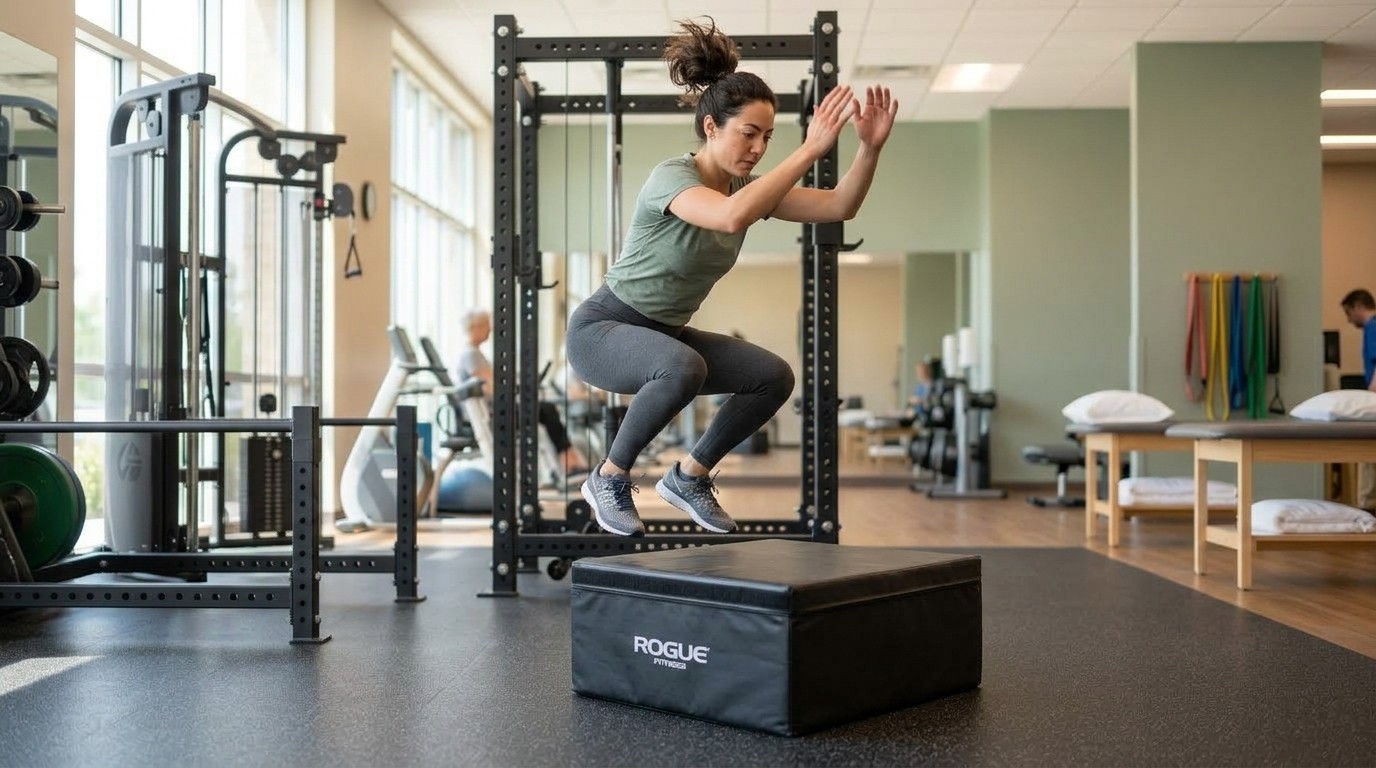
Once strength and control are in place, plyometric work: jumping, hopping, landing, and other explosive patterns rebuilds the power and shock absorption that daily life and sport demand. This is what bridges "I can move without pain" and "I can trust my body to handle a misstep, a curb, or a sprint for the bus." It's also central to safely returning to sport after injuries like sprains, ligament tears, and stress fractures.
4. Running Variations: Train the Way You Live
For runners and active people, generic exercise isn't enough. The body adapts to the demands you place on it. Tailored running progressions (intervals, tempo work, gradual mileage, gait-focused drills) rebuild capacity in a way that transfers directly to your goals, while reinforcing the movement quality built in earlier phases. The aim is a body that's prepared for what you actually ask of it, which is one of the best ways to prevent the next injury.
5. Aerobic Conditioning: The Long Game for Whole-Body Health
This is where short-term recovery meets long-term health, and the evidence is striking. Physical inactivity raises the risk of chronic disease, while regular activity lowers it across nearly every system in the body. Standard guidelines call for at least 150 minutes of moderate-intensity aerobic activity per week (or 75 minutes of vigorous activity) for adults.
The prevention payoff (as in risk reduction) is hard to overstate. Consistent physical activity is associated with:
Up to an 80% reduction in cardiovascular disease risk
Up to a 90% reduction in type 2 diabetes risk
About a 33% reduction in cancer risk, with cancer mortality reduced roughly 7–17% as activity rises
In exercise-based cardiac rehabilitation, cardiovascular mortality dropped by around 8–10% and hospital re-admissions by 26–31%. Activity also improves insulin sensitivity in people with type 2 diabetes, strengthens the immune system, supports brain health and cognition, and eases symptoms of depression and anxiety. One way to frame it: while medications often treat a symptom or alter the body synthetically, exercise prompts your own systems to function more optimally which is why researchers increasingly describe exercise as medicine.
Education Is What Makes It Stick
A coaching approach lives or dies on what happens between sessions. A core aim of physical therapy is to show you what you can do yourself to improve your own health: the treatment doesn't stop at the clinic door, and the exercises only work if you keep doing them at home. The bigger goal isn't fixing one joint; it's raising your overall activity for life.
That's the difference between being a passive patient and an informed participant. When you understand why a movement helps, how to progress it safely, and what to keep doing, you carry the gains forward long after discharge. Education turns a treatment plan into a lifelong skill set.
Short-Term Wins, Long-Term Health
The Pain & Performance Physical Therapy model is designed to deliver on both timelines at once:
Short term: calm the pain, restore clean movement, and get you back to the activities that matter now.
Long term: build strength, power, and aerobic capacity that lower your risk of chronic disease, protect your bones and joints, prevent the next injury, and keep you independent and capable for decades.
It applies whether you're managing back, neck, or joint pain; recovering from a sports injury or joint replacement; navigating osteoporosis, arthritis, or a neurological condition like Parkinson's, stroke, or multiple sclerosis; or simply trying to keep a chronic condition in check. The broader benefits such as avoiding surgery, managing chronic pain, preventing falls, and reducing the need for prescription drugs follow naturally. There's even a cost angle: one hospital guide reports that physical therapy can lower treatment costs by a substantial 72 percent (which actually means saving you money since insurance companies often make people's out of pocket costs much steeper than they'd like)
The Hillsboro Takeaway
You don't have to choose between "out of pain" and "performing at your best": a coaching-based physical therapy plan is built to take you all the way through. If you're in the Hillsboro, OR area and pain has shrunk what your body is willing to do, the right plan can do more than fix it. It can leave you stronger, more capable, and better prepared for life than you were before the injury.
The best outcomes start with the right guidance and continue with what you do on your own.
Call us at 971-364-0909 if you want help getting started on your recovery journey.
This article is for general educational purposes and isn't a substitute for personalized advice from a licensed healthcare professional.
Don’t Miss Out
Join our newsletter to get latest research insights.
References
InformedHealth.org [Internet]. Cologne, Germany: Institute for Quality and Efficiency in Health Care (IQWiG); 2006-. In brief: Physical therapy. Updated March 19, 2024. Accessed May 30, 2026. https://www.ncbi.nlm.nih.gov/books/NBK561514/ Wooster Community Hospital. The benefits of physical therapy: a comprehensive guide. Published April 7, 2023. Accessed May 30, 2026. https://www.woosterhospital.org/the-benefits-of-physical-therapy-a-comprehensive-guide/ Anderson E, Durstine JL. Physical activity, exercise, and chronic diseases: a brief review. Sports Med Health Sci. 2019;1(1):3-10. doi:10.1016/j.smhs.2019.08.006
The Pain & Performance Coach approach to physical therapy in Hillsboro, OR uses tailored strength training, neuromuscular retraining, plyometrics, and running to move you from pain relief to lasting performance.