
Your ACL Recovery Toolkit: 5 Free Resources Every Patient Should Know About
By
Dr. Mike Makher
Tore your ACL? Learn about 5 free ACL rehab resources. Physical therapy for patients in Hillsboro, North Plains, Cornelius, Forest Grove and Aloha, OR.
Disclaimer: This article is for educational purposes only. It should not be seen as medical advice. Every case and person is unique, so treatment and prevention should be customized by a licensed professional.
Your ACL Recovery Toolkit: 5 Free Resources Every Patient Should Know About
So you tore you or your loved one tore an ACL. Maybe it happened on the soccer field or landed awkwardly after a jump in basketball. Maybe you had a freak injury and twisted your knee the wrong way on a hike. However it happened, you are probably feeling a lot of things like fear, frustration, and confusion.
That is normal. An ACL tear is a big deal, and the road back is long. But here is some good news: you don't have to figure any of this out alone. Some of the best sports doctors and physical therapists in the world have made guides to help people just like you.
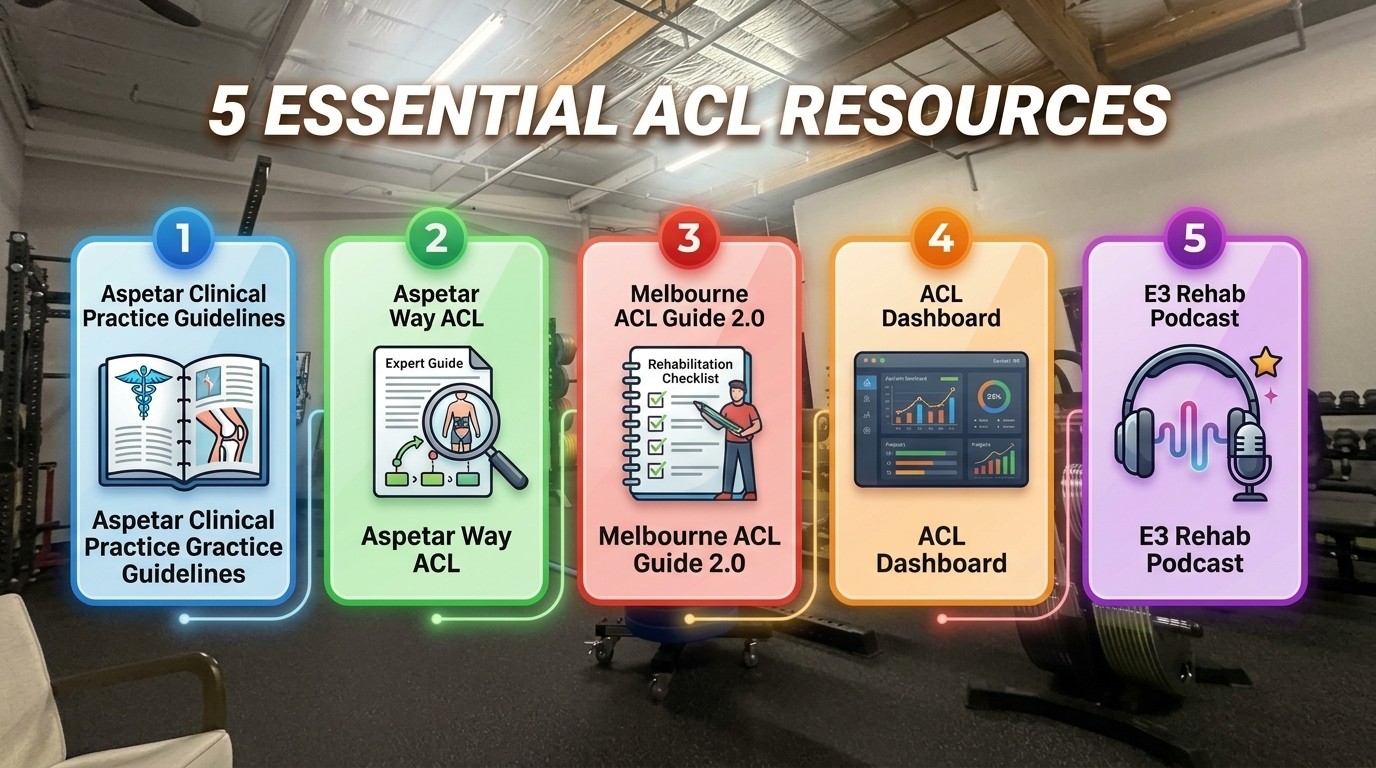
In this article, we will walk through five of our favorite resources:
The Aspetar Clinical Practice Guideline for ACL Reconstruction
The Aspetar Way article
The Melbourne ACL Rehabilitation Guide 2.0
The ACL Dashboard
The E3 Rehab Podcast
We will explain what each one is, why it matters, and how you can use it. Let's get started.
First, What Is the ACL?
ACL stands for anterior cruciate ligament. That's a mouthful, so let's make it simple.
Your knee is where your thigh bone meets your shin bone. Ligaments are like strong ropes that hold those bones together. The ACL is one of the most important ropes in your knee and it sits right in the middle to keep your shin bone from sliding too far forward. It also helps your knee stay steady when you twist, turn, or stop fast.
When the ACL tears, the knee can feel unstable. It might "give out" when you try to cut or pivot. Many people choose surgery to rebuild the ACL. The most common type of surgery for this injury is called ACL reconstruction.
Honestly the real work happens in rehab, and that's where these five resources come in.
Why Rehab Matters So Much
Here is something many people don't know. Getting back to sports after ACL surgery is hard. A large 2014 review by Dr. Clare Ardern (a researcher and the chief editor for the Journal of Sports and Orthopedic Physical Therapy) and her team looked at many studies. They found that about 81% of people went back to some kind of sport, but only about 65% got back to the same level they played before, and only 55% went back to competitive sports. Now this doesn't apply to the most elite professional athletes but if you're not in the pros yet, then the numbers I'm citing do matter in your case.
Furthermore, young athletes who go back to sports have a real chance of hurting their knee again. A 2016 study by Dr. Amanda Wiggins and her team found that people under 25 who returned to sports had a much higher chance of a second ACL injury than the general population.
We are not telling you this to scare you but because it shows why good rehab is so important (and most people don't get it). The resources below were made to help you recover the right way and lower your chances of getting hurt again.
Resource #1: The Aspetar Clinical Practice Guideline (the super technical science based recommendations)
What Is It?
Aspetar is a famous sports medicine hospital in Doha, Qatar. They treat some of the best athletes in the world, including pro soccer players.
In 2023, a team of experts led by Dr. Roula Kotsifaki published a guideline on ACL rehab. A guideline is like a rulebook written by experts. They looked at the research and then agreed on the best way to do things.
This one was published in the British Journal of Sports Medicine, which is one of the top sports medicine journals out there. It's basically the gold standard for modern ACL rehab.
What Does It Say?
The guideline covers your whole recovery, from before surgery all the way to getting back on the field. Here are some of the big ideas, in plain words:
The guideline supports doing rehab before your operation. This is sometimes called "prehab." The goal is to get your swelling down, get your knee moving well, and get your thigh muscles strong before surgery. People who go into surgery with a stronger, calmer knee often do better afterward.
Control pain and swelling early. In the first weeks after surgery, your knee will be sore and puffy. Getting that under control is job number one. Swelling can make your thigh muscle "shut off," which slows everything down.
Build big strength in your quads. Your quadriceps (or "quads") are the muscles on the front of your thigh. After ACL surgery, they get weak fast. The guideline makes quad strength a top goal. Your PT may use things like electrical muscle stimulation or special exercises to wake those muscles up.
Move forward based on skills, not just the calendar. This is one of the most important ideas. In the past, many people were told things like "You can run at 3 months" or "You can play at 6 months." The guideline says time alone is not enough. You should only move to the next stage when you pass certain tests, like strength tests or hop tests. This is called "criteria based" rehab.
Check your mind, too. Fear of getting hurt again is real. The guideline says your mental readiness should be checked before you go back to sports.
Why It Matters to You
This guideline is what many of the very best physical therapists will reference to plan your care. When you know what's in it, you can ask better questions and understand why your PT asks you to do certain things.
Resource #2: The Aspetar Way
What Is It?
The guideline above is written mostly for doctors and physical therapists. It can be hard to read. That's where the Aspetar Way article comes in.
This article explains how the team at Aspetar (a team at the world's very best sport rehab hospital in the world) actually runs ACL rehab day to day. Think of the guideline as the rulebook, and the Aspetar Way as the playbook. It shows how the rules turn into real sessions with real athletes.
What Does It Say?
The Aspetar Way breaks rehab into clear stages. Each stage has:
A goal (like "get full knee straightening" or "start running")
The kinds of exercises used in that stage
The tests you need to pass before you move on if you were working with their team
One big theme is that rehab should look more and more like your sport as you get better. Early on, you might be doing simple leg lifts. Later, you'll be jumping, landing, cutting, and doing drills that look like your actual game. By the end, the goal is for you to be ready for the speed and chaos of real play, not just the gym.
Why It Matters to You
This article helps you see the "big picture." Rehab can feel slow and boring at times. When you understand where each stage leads, it's easier to stay patient and keep working hard.
Resource #3: The Melbourne ACL Rehabilitation Guide 2.0
What Is It?
The Melbourne ACL Rehabilitation Guide 2.0 was written by two physical therapists from Melbourne, Australia: Randall Cooper and Mick Hughes. It came out in 2018 and is free to download online.
This guide is very popular with physical therapists around the world. One reason is that it's practical. It lays out each phase of rehab with clear goals and checklists.
What Does It Say?
The Melbourne Guide splits recovery into phases. It starts before surgery and goes all the way to returning to sport. For each phase, it lists:
What you should be working on
Example exercises
What you need to be able to do before moving on
For example, before you start running, the guide lists things you should be able to do first, like having very little swelling, good knee motion, and enough leg strength. Before you return to sport, it lists tests like strength testing and hop tests. The idea is that your injured leg should be close to as strong and capable as your healthy leg.
Many clinicians use something called the "limb symmetry index." That's a fancy way of comparing your injured leg to your good leg. If your good leg can hop 100 inches and your injured leg can hop 90 inches, your score is 90%. Many guides, including this one, use about 90% or higher as a target before returning to sport.
Why It Matters to You
The Melbourne Guide is great for patients who like checklists that are very easy to read. You can look at it with your PT and see exactly where you are and what comes next. It turns a long, scary process into small steps you can check off one at a time.
Resource #4: The ACL Dashboard
What Is It?
The ACL Dashboard is a tool that shows your rehab progress in a visual way. Instead of a pile of numbers, you get a clear picture of how you're doing.
Think about the dashboard in a car. It shows your speed, your gas, and warning lights all in one place. An ACL dashboard does the same thing for your knee. It can show your strength, your hop test results, your knee motion, and even how confident you feel, all on one screen or page.
What Does It Track?
Dashboards like this often include:
Strength scores, like how strong your quads and hamstrings are compared to your other leg
Hop test results, which show how well your leg handles jumping and landing
Range of motion, or how well your knee bends and straightens
Mental readiness scores, often from a survey called the ACL-RSI, which was created by Dr. Kate Webster and her team to measure how ready and confident you feel to return to sport
Why It Matters to You
Seeing your progress helps. On hard days, you can look back and see how far you've come. It also helps you and your PT make smart choices together. If one number is lagging, you both know what to work on next. Also if your PT isn't looking at any of the data cited in the dashboard (for example torque or LSI), then it's probably a sign you should look for a new PT.
Resource #5: The E3 Rehab Podcast
What Is It?
Not everyone likes to read long guides. Some people learn better by listening. If that's you, the E3 Rehab Podcast is a great choice.
E3 Rehab is run by Mark Surdyka, Tony Comella, and Chris Hughen, who are physical therapists. Their podcast covers all kinds of injury and rehab topics, and ACL recovery comes up often. You can listen for free on most podcast apps, like Apple Podcasts and Spotify, and they also post videos on YouTube.
What Does It Cover?
The E3 team talks about rehab in plain, everyday language. On their ACL episodes, you'll hear about things like:
Why lifting heavy weights is an important part of ACL rehab
How to know when you're ready to run, jump, or play again
How to deal with fear and frustration during a long recovery
Common myths about knee injuries, and what the research really says
They also explain the "why" behind exercises. When you understand why you're doing something, it's easier to stick with it.
Why It Matters to You
You can listen while you drive, walk, or ride the exercise bike. It's an easy way to keep learning without sitting down to read. And hearing experts explain things out loud can make the ideas in the other guides click.
A good place to start: [add the name or number of your favorite ACL episode].
The Big Lessons From All Five Resources
These resources come from different places and different teams. But they agree on a lot. Here are the main lessons:
1. Don't rush it. A well known 2016 study by Dr. Hege Grindem and her team followed athletes in Norway. They found that for every month athletes waited to return to sport (up to 9 months after surgery), their chance of hurting their knee again went down by about half. Patience really pays off.
2. Pass the tests. That same study found that athletes who passed return to sport tests had a much lower chance of hurting their knee again than those who didn't. The calendar is not enough. Your body needs to be ready.
3. Strength is king. Every resource puts a big focus on getting your leg strong, especially your quads. Weak legs are a major risk factor for a second injury.
4. Your mind matters. Feeling scared or unsure is normal. But it's something you and your PT should talk about and work on, just like strength.
5. Rehab is a team effort. You, your surgeon, and your physical therapist all play a part. The more you understand the plan, the better you can do your part.
How to Use These Resources
You don't need to read every page of every guide. Here's a simple plan:
Start with the Melbourne Guide. It's the easiest to follow and gives you a clear map of each phase.
Skim the Aspetar Way. It will help you understand how top sports teams handle rehab.
Listen to the E3 Rehab Podcast. Put on an ACL episode during your commute or your bike warmup. It's an easy way to learn more without extra reading.
Bring questions to your PT. If something in the guideline confuses you, ask. A good PT will be happy to explain.
Ask about tracking your progress. Ask your PT if they use a dashboard or similar tool to show your test results over time.
One important note: these resources are meant to support your care, not replace it. Every knee is different. Your PT will adjust your plan based on your surgery, your body, and your goals.
How We Can Help
At Pain & Performance Coach LLC, we build our ACL rehab programs around the same research you just read about. We use cutting edge science driven testing, so you move forward when your knee is ready, not just when the calendar says so. We test your strength, track your progress, and help you build the confidence to get back to what you love.
Whether you're about to have surgery or you're months into rehab and feeling stuck, we're here to help. Call us at 971-364-0909 or book online at our portal link .
Your ACL recovery is a marathon, not a sprint. But with the right plan and the right team, you can cross the finish line stronger than before.
References
ACL Dashboard. [Chris Kuenze, PhD, ATC and Arrow Team, 2023, https://acldashboard.com/]
Ardern CL, Taylor NF, Feller JA, Webster KE. Fifty-five per cent return to competitive sport following anterior cruciate ligament reconstruction surgery: an updated systematic review and meta-analysis including aspects of physical functioning and contextual factors. British Journal of Sports Medicine. 2014;48(21):1543-1552.
Aspetar. The Aspetar Way: ACL rehabilitation. Aspetar Sports Medicine Journal. [Enda King, 2025, Aspetar Sports Medicine Journal]
Cooper R, Hughes M. Melbourne ACL Rehabilitation Guide 2.0. 2018. Available free online.
Grindem H, Snyder-Mackler L, Moksnes H, Engebretsen L, Risberg MA. Simple decision rules can reduce reinjury risk by 84% after ACL reconstruction: the Delaware-Oslo ACL cohort study. British Journal of Sports Medicine. 2016;50(13):804-808.
Kotsifaki R, Korakakis V, King E, et al. Aspetar clinical practice guideline on rehabilitation after anterior cruciate ligament reconstruction. British Journal of Sports Medicine. 2023;57(9):500-514.
Surdyka M, Comella T, Hughen C. E3 Rehab Podcast. E3 Rehab. [youtube.com/watch?v=5SZCNLagr2o&themeRefresh=1 , October 2025]
Webster KE, Feller JA, Lambros C. Development and preliminary validation of a scale to measure the psychological impact of returning to sport following anterior cruciate ligament reconstruction surgery. Physical Therapy in Sport. 2008;9(1):9-15.
Wiggins AJ, Grandhi RK, Schneider DK, Stanfield D, Webster KE, Myer GD. Risk of secondary injury in younger athletes after anterior cruciate ligament reconstruction: a systematic review and meta-analysis. American Journal of Sports Medicine. 2016;44(7):1861-1876.
Don’t Miss Out
Join our newsletter to get latest research insights.
References
ACL Dashboard. [Chris Kuenze, PhD, ATC and Arrow Team, 2023, https://acldashboard.com/] Ardern CL, Taylor NF, Feller JA, Webster KE. Fifty-five per cent return to competitive sport following anterior cruciate ligament reconstruction surgery: an updated systematic review and meta-analysis including aspects of physical functioning and contextual factors. British Journal of Sports Medicine. 2014;48(21):1543-1552. Aspetar. The Aspetar Way: ACL rehabilitation. Aspetar Sports Medicine Journal. [Enda King, 2025, Aspetar Sports Medicine Journal] Cooper R, Hughes M. Melbourne ACL Rehabilitation Guide 2.0. 2018. Available free online. Grindem H, Snyder-Mackler L, Moksnes H, Engebretsen L, Risberg MA. Simple decision rules can reduce reinjury risk by 84% after ACL reconstruction: the Delaware-Oslo ACL cohort study. British Journal of Sports Medicine. 2016;50(13):804-808. Kotsifaki R, Korakakis V, King E, et al. Aspetar clinical practice guideline on rehabilitation after anterior cruciate ligament reconstruction. British Journal of Sports Medicine. 2023;57(9):500-514. Surdyka M, Comella T, Hughen C. E3 Rehab Podcast. E3 Rehab. [youtube.com/watch?v=5SZCNLagr2o&themeRefresh=1 , October 2025] Webster KE, Feller JA, Lambros C. Development and preliminary validation of a scale to measure the psychological impact of returning to sport following anterior cruciate ligament reconstruction surgery. Physical Therapy in Sport. 2008;9(1):9-15. Wiggins AJ, Grandhi RK, Schneider DK, Stanfield D, Webster KE, Myer GD. Risk of secondary injury in younger athletes after anterior cruciate ligament reconstruction: a systematic review and meta-analysis. American Journal of Sports Medicine. 2016;44(7):1861-1876.
Tore your ACL? Learn about 5 free ACL rehab resources. Physical therapy for patients in Hillsboro, North Plains, Cornelius, Forest Grove and Aloha, OR.
What New Research on Achilles Tendon Recovery Means for Both of Your Legs
Sep 21, 2026
By
Dr. Mike Makher
What New Knee Research Means for Patients in Hillsboro, Beaverton, Aloha, and Nearby Towns
Sep 6, 2026
By
Dr. Mike Makher

ACL Tear: Is Surgery Your Only Option, or Can Physical Therapy Alone Get You Back to Sport?
Aug 23, 2026
By
Dr. Mike Makher