Can You Stop? The Missing Piece in Return to Sport Testing

By
Dr. Mike Makher
Jump height and 90% symmetry can miss braking deficits after ACL or Achilles surgery. Hillsboro, OR physical therapists explain safer return to sport.
Disclaimer: This article is for educational purposes only. It should not be seen as medical advice. Every case and person is unique, so treatment and prevention should be customized by a licensed professional.
Can You Stop? The Missing Piece in Return to Sport Testing |
Is Jump Height Enough to Return to Sport?
This article is for educational purposes only. It summarizes research published in JOSPT Open and does not replace medical advice, diagnosis, or treatment. Reading it does not create a patient and provider relationship with Pain & Performance Coach Physical Therapy. Recovery after ACL reconstruction or Achilles tendon repair differs from person to person, and the reference values above come from specific groups of college athletes. Talk with your surgeon and physical therapist before starting new exercises or making any return to sport decision.
Jump height and limb symmetry scores can look normal while an athlete still struggles to slow down, land, and change direction. A June 2026 clinical commentary in JOSPT Open argues that return to sport testing should also measure how you brake, using force plate data from a simple countermovement jump.
Sports physical therapists Neil Sheth, PT, DPT, SCS, CSCS, and Jess Elis, PT, DPT, OCS, SCS, COMT, CSCS, FAAOMPT, wrote the paper as an update to their earlier Decel to Excel framework. Their concern is practical. Athletes often get cleared on numbers that miss deceleration, the skill most tied to injury during cutting and stopping.
Many athletes coming back from ACL reconstruction or Achilles tendon repair describe the same experience. They feel strong in the gym. Then the first hard cut or sudden stop on the field feels shaky, slow, or unsafe. The research below explains why that happens and what you and your physical therapist can do about it.
Key Takeaways
Deficits in jump performance and force production can persist long after ACL reconstruction, even in athletes who have already returned to sport.
Braking (eccentric) asymmetry between legs is often as large as push-off (concentric) asymmetry, yet many return to sport tests focus on jump height or about 90% limb symmetry.
Push-off strength tends to recover sooner than braking strength, so an athlete can pass a symmetry test while braking deficits remain.
Six force plate metrics from the countermovement jump point to specific weak links, and the authors match each one to targeted training.
The authors recommend repeat testing over time and warn against using force plate numbers alone to clear an athlete.
What Is a Countermovement Jump Test?
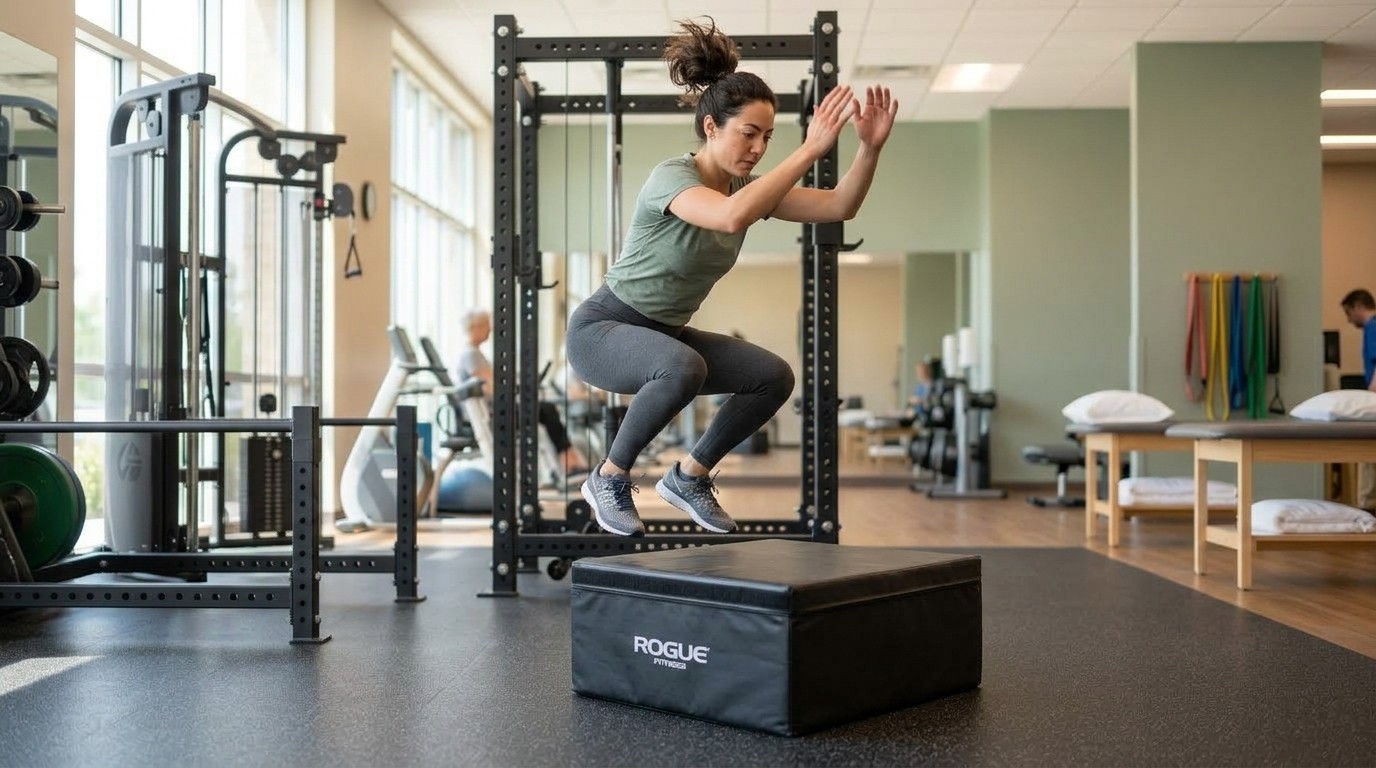
A countermovement jump (CMJ) is a vertical jump where you stand tall, dip down quickly, and jump as high as you can, usually with your hands on your hips to isolate the legs. On force plates, the test records how much force each leg produces, how fast, and during which phase of the jump.
Sheth and Elis call the CMJ a cornerstone test for lower-limb function. It takes little practice, runs in a few minutes, and has growing evidence for its reliability and its sensitivity to changes in neuromuscular performance. Clinicians can test both legs together or one leg at a time.
The force plate software splits the jump into phases. The eccentric phase is the dip, when your muscles lengthen under load to absorb and slow your body. The authors break the braking part of that dip into a yielding subphase and a deceleration subphase, which runs from your fastest downward speed until you stop at the bottom. The concentric phase is the push off the ground, followed by flight and landing.
Jump height shows the result. The force trace shows how you produced it, including which leg carries more of the work and which phase runs slow.
Why 90% Limb Symmetry Can Miss Deficits After ACL Reconstruction
Many return to sport protocols clear athletes once they jump high enough or reach about 90% symmetry between legs. According to Sheth and Elis, those criteria fail to capture deficits in braking and eccentric capacity, which are known injury mechanisms.
The research the authors review shows long-term deficits after ACL reconstruction across several force plate measures. These include peak eccentric and concentric force, eccentric and concentric impulse, rate of force development, and eccentric braking impulse. The authors link these deficits to quadriceps weakness, arthrogenic muscle inhibition (a reflex that limits quad activation after knee injury or surgery), altered muscle activation, and off-loading of the surgical leg.
Two findings stand out for anyone rehabbing a knee:
Braking asymmetry is often as large as push-off asymmetry, yet traditional rehab and testing tend to overlook it.
Push-off deficits often improve sooner than braking deficits. That timing lets an athlete reach 90% symmetry on the jump while still braking mostly with the uninjured leg.
For you, that means a passing jump score can sit alongside a surgical leg that still avoids load when you plant and cut.
Does This Apply to Achilles Tendon Repair Rehab?
The cited JOSPT Open paper focuses on ACL reconstruction and does not report Achilles-specific data. The authors frame their approach around lower-limb injury in general, and the qualities they target (braking, load absorption, and landing control) matter for any athlete returning to a jumping or cutting sport.
One detail in the paper points straight to the ankle. The authors note that athletes need to pre-activate and pre-tension the ankle, knee, and hip extensors before impact to produce the braking force that stops whole-body momentum. The ankle extensors are the calf muscles, which attach to the heel through the Achilles tendon.
The paper also describes a protective pattern after injury: athletes often adopt a slower, more cautious descent to avoid loading the involved limb. On the force trace, that guarded dip appears as a lower eccentric peak velocity, which the authors connect to reduced confidence and limited ability to drop into sport positions.
If you are rehabbing an Achilles repair, treat the specific numbers in this article as a general guide drawn from ACL and athlete research. Your physical therapist should decide how and when testing fits your tendon healing timeline.
6 Force Plate Metrics and What They Look Like on the Field
Sheth and Elis highlight six countermovement jump metrics. Each one points to a different weak link, and each lines up with a movement pattern you or your coach might notice on the field or court.
Metric | What it measures | What you might see in sport | Reference value (college athletes) |
|---|---|---|---|
Eccentric deceleration rate of force development (RFD) | How fast you build force while braking during the dip | Hesitant stops, drawn-out or extra steps, trouble getting low fast | Above 85 N/s/kg (men), above 80 N/s/kg (women) |
Eccentric braking impulse | Total force across the braking phase (force × time) | Upright trunk on the last two steps of a cut, knee caving inward, little knee bend, extra hops to balance on one leg | About 130 Ns (men), 99 Ns (women) |
Concentric impulse | Total force during push-off | Low jump height, slow re-acceleration after a cut, short choppy strides when speeding up | About 260 Ns (men), 174 Ns (women) |
Peak eccentric force | Highest force reached during braking | Trouble stopping suddenly, rounded cuts instead of sharp ones, unstable landings, wide stance while slowing down | No set target; varies with jump strategy |
Peak concentric force | Highest force at takeoff | Lower max jump, weak power from a standstill, incomplete triple extension or a double hitch at takeoff | About 25.9 W/kg (men), 23.5 W/kg (women), as reported |
Eccentric peak velocity | Fastest downward speed during the dip | Slow dip before jumping, poor reaction to surprises in play, stiff or rigid movement | At least 1.2 m/s downward (two-leg jump), 0.6 m/s (single-leg jump) |
The reference values come from normative data the authors cite, mostly from NCAA basketball athletes, and they note that some metrics have no true target value. If you are a high school athlete or a recreational player, your PT will lean on comparisons to your uninjured leg, your own baseline, and your progress across repeat tests. The authors also stress that these on-field patterns are correlations, not exact biomechanical matches.
How to Train Each Deficit
Once testing shows which phase limits you, the authors pair each metric with targeted training. These are late-stage rehab tools drawn from the paper. Your physical therapist chooses and doses them based on your surgery, your timeline, and your latest test results.
Slow braking (eccentric deceleration RFD)
The authors recommend eccentric overload, reactive deceleration drills, and high-speed cutting and stopping progressions. Examples include:
Fast-lowering squats and catch eccentrics
Snap-downs with added load or perturbation
Drop jumps with ground contact under 170 milliseconds
High-speed motorized or band-assisted eccentrics
Acceleration to deceleration drills, lateral and multidirectional
Poor braking control (eccentric braking impulse)
Catching and landing control tasks
Accentuated eccentric loading, with extra load during the lowering phase
Long-duration eccentrics with prolonged time under tension
Preplanned stopping drills with a known direction and timing
Assisted or constrained deceleration drills that guide movement strategy
Eccentric yielding isometrics, where you lower under control and then hold
Olympic lift derivatives such as full cleans and snatch balances
Low peak braking force (peak eccentric force)
Heavy slow eccentrics: a 4 to 6 second lowering at more than 85% of your 1-repetition maximum
Flywheel squats or knee extension eccentrics
High-load landing drills such as controlled depth drops
Low push-off output (concentric impulse and peak concentric force)
Olympic lift derivatives such as high pulls and hang power cleans
Ballistic training such as trap bar jumps and jump squats
Bounding and power-loaded plyometrics
Resisted sprints and band-resisted jumps
Speed squats and cluster sets (listed for concentric impulse)
Slow, guarded dip (eccentric peak velocity)
The authors call for eccentrically biased strength work:
Tempo eccentrics such as Nordic hamstring curls or squats with a 3 to 5 second lowering
Deceleration drills such as drop landings and braking steps
Plyometrics with an emphasis on landing control
The Decel to Excel Return to Sport Workflow
The authors lay out a six-step loop that repeats until the athlete is ready to return. Serial testing, meaning the same test repeated over the course of rehab, drives every decision.
Baseline testing and assessment. Collect force plate data that reflects the demands of your sport late in rehab.
Analyze key metrics. Identify the physical or mechanical deficit each number represents.
Identify deficits. Compare results to your uninjured leg, your own baseline, normative values, and your earlier tests.
Prescribe targeted interventions. Choose loading strategies that address the specific deficit.
Retest. Improvement means you progress. No change means your PT modifies the training. A decline means your PT reassesses how much load you tolerate and how you move.
Make a decision. Combine the data with the clinical exam, movement quality, field-based criteria, and psychological readiness.
The workflow also helps with communication. Sheth and Elis point out that objective numbers give clinicians, coaches, front offices, and parents a common reference point for tracking progress and planning the return.
What Force Plates Can't Tell You
Force plates measure ground reaction forces. They do not directly measure the stress on a graft, a tendon, or any other tissue inside your leg.
The authors state it in the paper: "Force plate metrics should not be interpreted as direct measures of tissue-level loading or used as isolated RTP clearance criteria." They describe force plate data as a practical bridge between lab research and the field. It shows how you brake, absorb, and push, without telling the whole story on its own.
A slow dip on the force plate suggests reduced confidence or stiffness control, and your PT confirms it by watching you move. A sound return to sport decision still depends on a skilled clinical exam, sport-specific movement testing, and an honest read on whether you feel ready.
Return to Sport Physical Therapy in Hillsboro, OR
If you play soccer, basketball, volleyball, football, or any sport with cutting and sudden stops, your return to sport plan should test how you slow down along with how high you jump. That applies whether you are a high school athlete, a college player home for the summer, or an adult in a weekend league.
Bring these questions to your next physical therapy visit:
Are we testing my braking, or only my jump height and symmetry?
How does my surgical leg compare to my other leg during the dip, separate from the push-off?
How often will we retest, and what will change in my program based on the results?
Do I move the same way on the field as I do on the test?
Pain & Performance Coach Physical Therapy helps athletes in Hillsboro and nearby Washington County communities return to sport after ACL reconstruction and Achilles tendon repair. Contact our team to schedule an evaluation and build a return to sport plan around your testing, your sport, and your goals.
Frequently Asked Questions
How long do strength deficits last after ACL reconstruction?
The research reviewed by Sheth and Elis shows that deficits in jump performance and force production can persist long after ACL reconstruction, even in athletes who have returned to sport. The paper gives no single timeline, which is why the authors recommend repeat force plate testing throughout rehab.
Is 90% limb symmetry enough to return to sport?
Symmetry alone can miss braking deficits. Push-off strength often recovers sooner than braking strength, so an athlete can reach about 90% symmetry on the jump while braking deficits remain. The authors recommend pairing symmetry with phase-specific force plate metrics and clinical judgment.
What is eccentric braking impulse?
Eccentric braking impulse is the total force you produce while slowing down during a jump, measured as force multiplied by time in newton-seconds. It reflects how well you control load while braking. Low values often trace back to off-loading the injured leg and incomplete recovery of quadriceps strength.
Does this research apply to Achilles tendon repair?
The paper centers on ACL reconstruction and reports no Achilles-specific results. Its principles of training braking, load absorption, and landing control after lower-limb injury still apply to athletes returning to sport after an Achilles repair. Your physical therapist adjusts testing and loading to your tendon healing timeline.
Can a force plate test clear me to return to sport?
No single test should clear you. The authors state that force plate metrics should not serve as isolated return to play clearance criteria. They recommend combining the data with a clinical exam, movement quality, field-based testing, and psychological readiness. We whole heartedly agree with this sentiment at Pain & Performance Coach Physical Therapy.
[Reference values in this article are as reported by Sheth and Elis, who cite VALD Performance normative data reports for college basketball and Premier League athletes.]
Disclaimer
This article is for educational purposes only. It summarizes research published in JOSPT Open and does not replace medical advice, diagnosis, or treatment. Reading it does not create a patient and provider relationship with Pain & Performance Coach Physical Therapy. Recovery after ACL reconstruction or Achilles tendon repair differs from person to person, and the reference values above come from specific groups of college athletes. Talk with your surgeon and physical therapist before starting new exercises or making any return to sport decision.
Don’t Miss Out
Join our newsletter to get latest research insights.
References
Sheth NB, Elis J. Decel to Excel: translating countermovement jump metrics into targeted rehabilitation strategies for return to play. JOSPT Open. 2026;4(3):247-253. doi:10.2519/josptopen.2026.0215
Jump height and 90% symmetry can miss braking deficits after ACL or Achilles surgery. Hillsboro, OR physical therapists explain safer return to sport.