
What New Research on Achilles Tendon Recovery Means for Both of Your Legs
By
Dr. Mike Makher
New research offers helpful insight into Achilles tendon rupture recovery and why both legs matter during rehab. See what it means for patients in Hillsboro, Beaverton, Aloha, and nearby areas.
Disclaimer: This article is for educational purposes only. It should not be seen as medical advice. Every case and person is unique, so treatment and prevention should be customized by a licensed professional.
If you're working through recovery from an Achilles tendon rupture in Hillsboro, Beaverton, Aloha, Cornelius, Forest Grove, North Plains, or Bethany, you already know the drill: strengthen the calf, protect the tendon, rebuild your confidence in the leg. That guidance holds up well. But a recent study out of Sweden and Iceland adds a helpful piece to the puzzle, one that's easy to miss if all the attention goes to the injured side.
It turns out your uninjured leg is working harder than most people realize, and it's worth a little attention too. Here's what the research found and what it means for a smart, well rounded recovery plan.
What the Researchers Studied
A team from the University of Gothenburg, the University of Delaware, and the University of Iceland followed 30 people who had experienced a midportion Achilles tendon rupture one to three years earlier. Participants had been treated both surgically and non surgically, and most were recruited through local physiotherapy clinics.
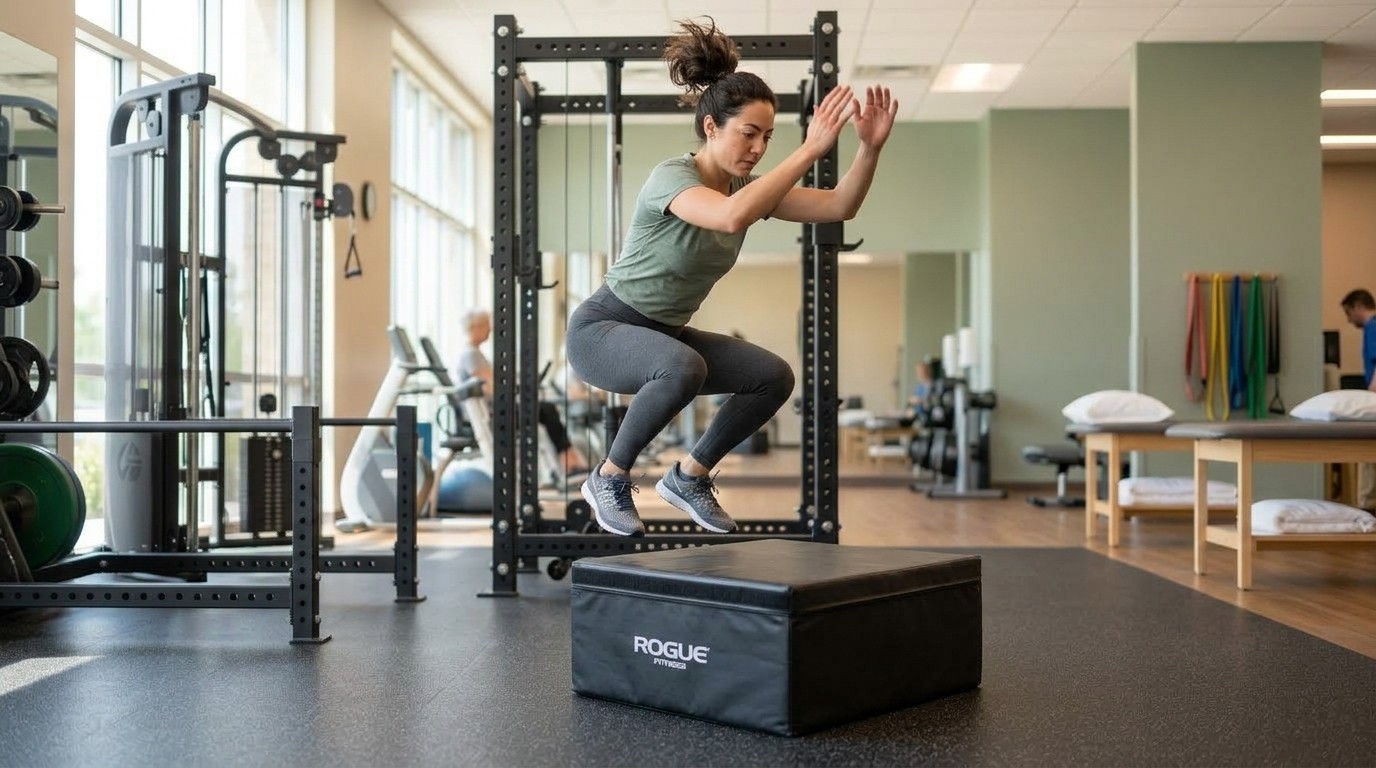
Each person performed single leg drop jumps off a 20 centimeter box, on both their injured and uninjured leg, before and after a structured fatigue routine. That routine paired a heel raise endurance test with five minutes of brisk lateral sliding, enough to bring participants to a genuinely tired state. Motion capture technology and a force plate tracked how the ankle, knee, and hip were sharing the workload during landing and takeoff, both when participants were fresh and after they'd worked up a real sweat.
The Interesting Discovery: Both Legs Have a Story to Tell
As expected, the injured ankle produced less power overall than the uninjured one, and it leaned a bit more on the knee to help out, a pattern that shows up in other Achilles research too. Nothing surprising there.
What's genuinely interesting is what happened after fatigue. The uninjured ankle actually lost more push off power than the injured ankle did. Jump height and speed followed a similar pattern. The uninjured leg jumped a little higher and faster to start, but it also cooled off more once fatigue set in.
The likely explanation is a pretty relatable one: many people lean on their uninjured leg during recovery, often without realizing it, especially for tasks that use both legs together. Over months and years, that leg quietly picks up more of the workload. This study is a nice reminder to make sure that leg gets some thoughtful attention too, not because anything is wrong with it, but because it's been doing a lot of unseen work.
Why This Is Actually Good News for Rehab
This finding doesn't mean anything is going wrong with your recovery. If anything, it's useful information that helps build a smarter, more complete plan. Most Achilles rehab rightly focuses early on healing, range of motion, and rebuilding calf strength on the injured side. This research simply suggests that once you're back to more demanding activity, jumping, sports, or a physically active job, it's worth also paying attention to how your other leg is holding up, especially later in a workout or a long day on your feet.
The study also found that fatigue affected landing mechanics a bit more than push off mechanics, on both legs.1 That's a helpful detail for anyone easing back into sports or higher level activity: landing control is worth just as much practice as jumping power.
What This Means for Your Recovery Near Hillsboro or Beaverton
If you or a family member is working through Achilles rehab anywhere in Hillsboro, Beaverton, Aloha, Bethany, Cornelius, Forest Grove, or North Plains, here's how to put this research to good use.
Build in some fatigue based training, when you're ready. A lot of progress checks happen when you're fresh and feeling good, which makes sense early on. As you get further along, it's helpful to also practice balance, jumping, and movement control after you've warmed up and worked a bit, since that's a more realistic picture of how your body performs day to day.
Give your other leg some love too. It's easy to assume the uninjured leg can handle anything. This research is a friendly reminder that it's been doing extra work, so a little extra strengthening and mobility attention on that side rounds out a recovery plan nicely.
Confidence is part of healing. The study's authors point out that trust in the injured leg plays a real role in how people move and compensate during recovery. Rebuilding that confidence, through guided practice and gradual progression, is just as valuable as building strength.
There's no rush, and no expiration date on progress. These participants were one to three years past their injury, well past the point where most people consider themselves done with rehab. The fact that useful patterns still showed up this far out is encouraging in its own way. It means there's still real value in checking in on your movement and mechanics, even years down the road.
Finding the Right Support Nearby
Achilles tendon recovery is rarely a straight line, and research like this helps physical therapists build more complete, thoughtful plans, ones that look at the whole picture rather than just the injured leg. Clinics across Hillsboro, Aloha, Beaverton, Bethany, Cornelius, Forest Grove, and North Plains are using insights like these to round out later stage rehab with fatigue based movement checks and a balanced approach to both legs.
If you're some months or even a couple of years past an Achilles tendon rupture and want a second look at how you're moving, especially after activity, a conversation with a physical therapist familiar with this research is a great next step. It's not about finding a problem. It's about making sure your recovery plan is as complete and confident as it can be.
The Bottom Line
New research on Achilles tendon rupture recovery offers a helpful, and honestly kind of encouraging, insight: your uninjured leg has been working hard for you, and it deserves a bit of attention too. For patients across Hillsboro, Aloha, Beaverton, Bethany, Cornelius, Forest Grove, and North Plains working through Achilles recovery, this is simply a nudge toward a more complete, well rounded plan, one that builds strength and confidence in both legs as you return to the activities you love.
Source cited: Jónsdóttir US, Tranberg R, Silbernagel KG, Brorsson A, Briem K. Effects of fatigue are more pronounced on the uninjured side during single-limb jumps 2 years after an acute Achilles tendon rupture. Knee Surg Sports Traumatol Arthrosc. 2026:1-8. doi:10.1002/ksa.70579
Don’t Miss Out
Join our newsletter to get latest research insights.
References
Jónsdóttir US, Tranberg R, Silbernagel KG, Brorsson A, Briem K. Effects of fatigue are more pronounced on the uninjured side during single-limb jumps 2 years after an acute Achilles tendon rupture. Knee Surg Sports Traumatol Arthrosc. 2026:1-8. doi:10.1002/ksa.70579
New research offers helpful insight into Achilles tendon rupture recovery and why both legs matter during rehab. See what it means for patients in Hillsboro, Beaverton, Aloha, and nearby areas.
What New Knee Research Means for Patients in Hillsboro, Beaverton, Aloha, and Nearby Towns
Sep 6, 2026
By
Dr. Mike Makher

ACL Tear: Is Surgery Your Only Option, or Can Physical Therapy Alone Get You Back to Sport?
Aug 23, 2026
By
Dr. Mike Makher

ACL Recovery Guide for Hillsboro, OR
Aug 13, 2026
By
Dr. Mike Makher